Phlebotomy Technician Course
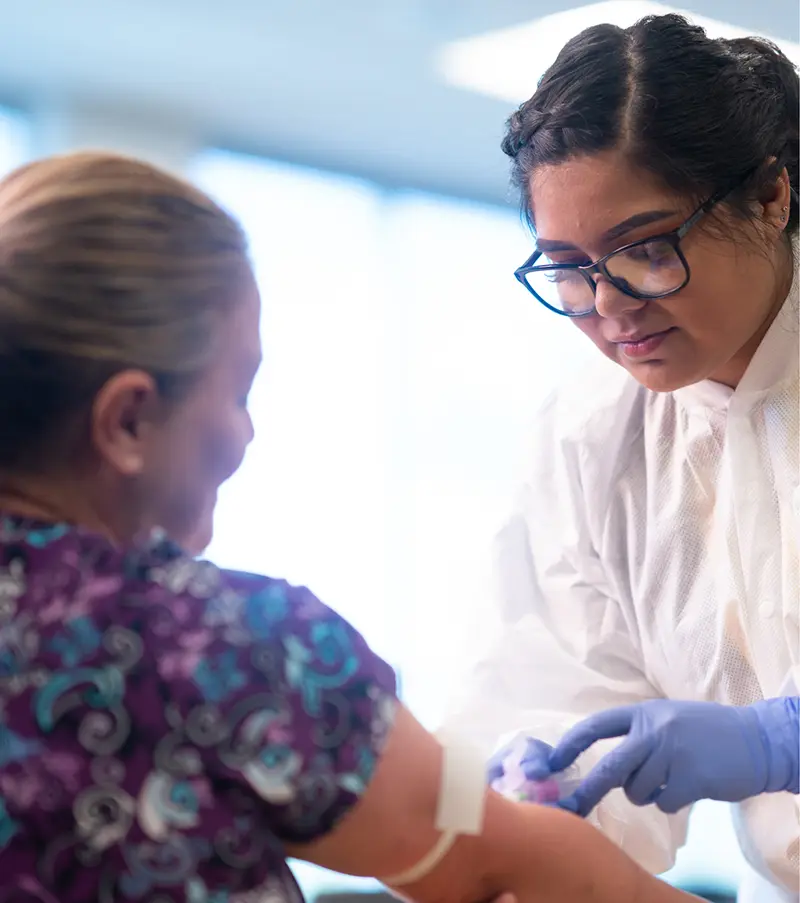
Carrington College’s Phlebotomy Technician course prepares graduates to help physicians determine a patient’s underlying health conditions by drawing blood for medical testing, research, and transfusions.

Request Information
All fields using an asterik (*) are required.
Request Information
All fields using an asterik (*) are required.
Program Details
What Will I learn
Military Policy
Cost & Financial Aid
Your education is an investment in your future, and Carrington College is here to help. We offer a variety of financial aid options, including federal, state, and private programs, as well as student loans, grants, and scholarships are available for those who qualify. Each program has different requirements and application instructions. Our team is here to guide you through the options and application process.
Academic Cost
For complete details on current tuition costs, please refer to the Academic Catalog.
Location Availability
Carrington College’s Phlebotomy Technician course is available at 1 location. To learn more, explore the location page.
Accreditation & Approvals
Carrington College is accredited by the Accrediting Commission for Community and Junior Colleges, 428 J Street, Suite 400, Sacramento, CA 95814; 415 506 0234 an institutional accrediting body recognized by the Council for Higher Education Accreditation and the U.S. Department of Education. Additional information about accreditation, including the filing of complaints against member institutions, can be found at accjc.org.
For comprehensive information on Carrington College’s accreditation and approvals, visit dev.carrington.edu/accreditation-and-approvals/.
Course Catalog
Program Specific Disclosures
Continuing Education For Graduates
Student Outcomes

REAL WORLD SKILLS

START YOUR PATH

FLEXIBLE LEARNING OPTIONS

AFFORDABLE TUITION
Phlebotomy Technician Career Opportunities
Phlebotomist technician training programs teach students how to safely and accurately draw blood from patients for medical testing, research, transfusions, and blood donations. Phlebotomists must be able to explain the procedure to patients and assist them if they have an adverse reaction, such as fainting, after their blood is drawn.
A phlebotomy technician may work in several environments, including: (1)
- State, local, and private hospitals
- Medical and diagnostic laboratories
- Ambulatory healthcare services
- Physicians’ offices
- Outpatient care centers
For more information on phlebotomist duties and career options, check out What Does It Take to Become a Phlebotomist?

BLOOD SPECIMEN COLLECTION

STANDARD PRECAUTIONS

SPECIMEN PROCESSING

RELATED BODY ANATOMY AND aFUNCTION
Why Choose a Phlebotomy Technician Program?
If you are interested in becoming an integral part of a healthcare team, becoming a Phlebotomy Technician may be an ideal career choice for you. Formal training provides hands-on learning and foundational healthcare knowledge combined with technical skill development, so you’ll enter the workforce with confidence in your abilities.
Is a Phlebotomy Technician Career Right for You?
The Phlebotomy Technician course might be a good fit for you if:
- You enjoy helping people
- You have a knack for putting people at ease in stressful situations
- You want a fast-track entry into the healthcare field
- You want to build some clinical experience before pursuing medical lab or nursing certifications
- You have a fine eye for detail and accuracy
Phlebotomy Technician Program FAQs
-
Phlebotomists draw blood from patients or donors for tests, transfusions, research, or donations. (1) A phlebotomist may need to speak with patients to make them feel comfortable during the blood draw, especially in settings where patients see few other medical professionals, such as testing or donation sites. After drawing blood, a phlebotomist accurately labels samples and enters patient information into databases.
-
According to the BLS, phlebotomists typically receive training from a phlebotomy post-secondary program. Some phlebotomists do enter the field with a high school diploma and receive on-the-job training, but employers typically prefer to hire those who have earned a professional certification. (1)
-
The two terms are often used interchangeably. “Phlebotomist” is an everyday title used by employers, while “phlebotomist technician” is the term preferred by certification bodies. The Carrington College Phlebotomy Technician program prepares students for the National Healthcareer Association Phlebotomy Technician Certification (CPT) exam.* (2)
-
The time to complete a phlebotomy course varies by institution. Carrington College’s Phlebotomy Technician course can be completed in as few as 3 months.
-
Some states require phlebotomists to have a license or certification. For specific requirements, contact your state licensing agency.
-
Phlebotomy technician program costs vary by institution and financial aid. Contact Carrington College’s Admissions department for more information.
-
The Phlebotomy Technician course teaches the skills and knowledge needed to take the National Healthcareer Association Phlebotomy Technician Certification (CPT) exam.*
-
Students must meet Carrington College’s admission requirements to meet the prerequisites of the Phlebotomy Technician course, including a high school diploma or equivalency. More information is available in the Phlebotomy Career Guide.
References:
- Bureau of Labor Statistics, U.S. Department of Labor. (2025, August 28). Phlebotomists. Occupational Outlook Handbook. https://www.bls.gov/ooh/healthcare/phlebotomists.htm
- National Healthcareer Association. (n.d.). Phlebotomy technician. NHA. https://www.nhanow.com/train-educate/professions/phlebotomy-technician
*Carrington College prepares students to take appropriate certification and licensure exams related to their individual majors. The College does not guarantee students will successfully pass these exams or be certified or licensed as a result of completing the program.