
 There’s no doubt that registered nursing can be one of the most rewarding professions that a person can choose. However, being a Registered Nurse (RN) can also be one of the most stressful jobs in today’s demanding health care field. Patients rely on registered nurses for many things, regardless of the setting, whether in a hospital ICU, the emergency room, in a clinic or home care setting. Nurses care for patients and are also responsible for their safety and to work closely with the other members of the health care team. They are responsible for patients’ physical care, but patients also count on nurses to be caring, to listen to their concerns, to serve as advocates and to explain the treatments and issues they face. They are also expected to be patient and assist family members and caregivers, to be fully competent and to always assure the patients’ safety. Nurses are also responsible to be full members of the health care team and to work with physicians and all the other staff. Multiple responsibilities, computer charting, and working in fast-paced environments where the demands are high and high risk can all be sources of stress. Often nurses find themselves falling into behaviors that really don’t serve them well. Common issues are lack of sleep, working longer shifts without breaks, not eating well or regularly, and not practicing health-promoting activities. These issues can result in today’s nurses feeling stressed and overwhelmed. But after talking with many long time nurses, the work of nursing can also bring great rewards, as well as being a good career choice and offering many long-term benefits.
More Nurses Required
 Why is it important for nurses to find ways to manage stress? Nurses are needed. By 2030, just 15 short years away, there will be 72+ million people in the U.S. aged 65 or older, which is more than twice the number from 2000.1 That will represent 19% of the population in 2030, which means that the demand for qualified RNs is only going to increase in the future.1 Nurses are getting older too. The average age of RNs increased by nearly two years, from 42.7 years in 2000 to 44.6 years in the 2008-to-2010 period.1 Nearly one million nurses aged 50+ (almost 33% of nurses) will be reaching retirement age in the coming decade or so.1 So it’s clear that nursing offers good career prospects now and in the years to come, but how can new or continuing nurses handle the stress?
Stress Relief Tips
Stress affects people in different ways, and at different levels. So it’s important to choose and practice the stress relief techniques that work for you. If you’re looking to reduce your stress levels after a demanding or difficult shift, try a few of these tips. Hopefully you’ll find some combinations that work for you.*
- Aromatherapy – Many people swear by the calming influence of essential oils like lavender, either in a long hot bath, in a diffuser, or a drop on the wrist or forearm.
- Keep a journal – Get things off your chest and write down your angst. Expressive writing has been shown to give many people a sense of release. It’s sharing without the sharing for those don’t like to “complain” to others.
- Exercise – Everyone knows exercise has a positive effect on stress levels. Try to fit in a workout, a yoga class, or even a 30 minute walk for some fresh air every day or two.
- Breathing techniques – You don’t have to go as far as meditation, although some might, but there are a number of different breathing techniques that help relax and regain a sense of peace.
- Rest your legs – You’re on your feet all day. Have you tried resting your legs up a wall? This article explains how, and shares the 5 amazing health benefits of this simple pose.
- Switch off spot – On your commute home, don’t focus on work all the way to the door. Pick a spot on your journey where you force yourself to switch off from work, and focus on your home life.
- Time management – Some things we have no control over, but other stresses we may bring on ourselves due to habits that create a lack of order. Read these five time management tips for busy nurses.
- Ask your employer if they offer an SMP (stress management program). Almost half of employers in the United States provide some type of stress management training for their workforces.2
 Laughter is often the best medicine – Find time to socialize with friends and family. Make time to get out and enjoy yourself. Even if you have to schedule it on a calendar to make it happen!
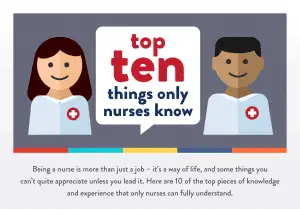
- Smile – Because there are certain things only a nurse can understand!
*The information, facts, and opinions provided here are not meant as a substitute for professional advice. Always consult your primary healthcare provider for any medical advice, diagnosis, or treatment and before undertaking a new diet or exercise plan for stress relief.
1 – According to the U.S. Department of Health & Human Services.
2 – National Institute of Occupational Safety and Health. Stress at Work. US National Institute for Occupational Safety and Health, DHHS (NIOSH) Publication Number 99-101. 1999.